How Lumino approaches Wikipedia
Wondering what it takes to edit your company's Wikipedia article, or to publish a new one? Looking to make changes to an article about a company executive? We've got you covered. Here are the questions Lumino gets asked most often about Wikipedia, with our answers based on over a decade of experience working on the site.
Working with Lumino
Companies, agencies, and notable individuals hire Lumino because our team knows how to navigate Wikipedia's complex guidelines and engagement requirements. Lumino has helped countless Fortune 500 companies and prominent nonprofits collaborate with editors to update articles, and we are deeply familiar with best practices for ethical engagement on this unique, community-run platform. Our agency was founded in 2020 by three veteran marketers and Wikipedia experts: Rhiannon Ruff, Sheri Cook-Sandve, and Andrew Burnett. Lumino is committed to upholding the values of the Wikimedia Foundation and working transparently with Wikipedia's community of volunteer editors—and we hold our clients to the same standard.
Why should I hire Lumino?
Does Lumino offer guarantees?
How much does Wikipedia consulting cost?
Can I keep requesting updates after our engagement ends?
Does Lumino offer long-term Wikipedia monitoring?
How is Lumino different from other Wikipedia vendors?
Lumino is unlike many vendors and agencies that make unrealistic "guarantees" about Wikipedia and operate in ways that violate Wikipedia's guidelines for users with a conflict of interest (COI). These vendors may claim they employ Wikipedia administrators, edit from multiple accounts without disclosing a conflict of interest, or state that they can get changes made immediately. Each of these is a major red flag. Engaging vendors who disregard Wikipedia's rules usually results in edits that get reversed, banning of accounts, and damage to your brand's reputation.
There are several agencies that do operate ethically on Wikipedia. These agencies follow Wikipedia's guidelines, collaborate with editors, and are transparent with clients that it is impossible to guarantee specific outcomes on Wikipedia. What makes Lumino unique among these is our approach to Wikipedia education. Unlike other agencies that take over your Wikipedia engagement, Lumino believes in educating our clients about how Wikipedia actually works and how to engage effectively with editors. This empowers our clients to manage their Wikipedia presence on their own after their partnership with us, rather than leaving them dependent on an agency for ongoing support.
Another key distinguishing characteristic is our background in corporate comms and marketing. All of our agency's key personnel have experience partnering with large brands on social media, public relations, and thought leadership projects beyond Wikipedia. That means we consistently overdeliver on project communication and management, and ensure client leads are empowered to provide updates to stakeholders in upper and middle management throughout the engagement. We understand that Wikipedia is one of many initiatives competing for scarce time and resources, and we work closely with your team to identify key goals, flag project setbacks, and celebrate big wins.
Does Lumino have case studies?
Engaging on a Wikipedia article about a brand or executive is a sensitive communications endeavor, and many of our clients choose to be discreet about their efforts on the site. We do, however, conduct our own analyses of our success on Wikipedia. Since January 1, 2025, our edit requests on Wikipedia have a success rate of ~74%—meaning that editors take our requested updates live exactly as we proposed them, or they make only minor formatting or sourcing changes.
If you'd like to know more about our track record of success on Wikipedia and see case studies, please reach out to us to set up a call: shout@luminodigital.com
What is Lumino's process for engaging on Wikipedia?
Does Lumino employ Wikipedia editors or administrators?
Can Lumino submit an article draft I wrote?
Lumino is a Wikipedia agency that operates in full alignment with the site's policies, guidelines, and community standards. We don’t “control” articles, make undisclosed edits, or promise outcomes that would violate Wikipedia's encyclopedic content guidelines. Instead, Lumino helps companies and organizations transparently participate on the site to successfully engage with the editor community.
Our process starts by meeting with your team to learn your goals and expectations for the project. We then dive into deep research on your company or company executive, with a focus on coverage in sources that are considered reliable for Wikipedia. This research informs the strategy we develop for our Wikipedia engagement. For the remainder of the project, we guide your team through proposing edits via Wikipedia Talk pages, responding to editors, and navigating the complexities of engaging with the editor community. Our approach equips you with the skills necessary to continue the engagement through your disclosed account even after you've stopped working with us.
In an interview with Molly McPherson's PR Breakdown podcast, Lumino co-founder Andrew Burnett talked about Lumino's approach to guiding clients through Wikipedia engagement:
We are the one-stop ethical Wikipedia firm that follows the rules. Even if it doesn't make sense for you to engage [right now], we'll inform you about the trapdoors so you don't get yourself into trouble [in the future].
Listen to The Real Scoop on How to Get a Wikipedia Page on the PR Breakdown podcast.
No, Lumino does not employ Wikipedia administrators or editors who edit Wikipedia directly, as doing so would be a major violation of Wikipedia's conflict of interest guidelines. Instead, we guide your team step-by-step through the process of disclosing a conflict of interest and transparently proposing edits via a Wikipedia article's Talk page.
We often hear from companies or executives looking to publish a new Wikipedia article who say, "we already have a draft!" While a draft can be a helpful starting point for us at Lumino, we will not help submit any draft before carefully evaluating it. We'll start by doing deep research into the company or executive to give you an honest assessment of whether we think the topic is sufficiently "notable," by Wikipedia editors' standards, to qualify for a standalone article.
The hard truth, confirmed by our research into Wikipedia's Articles for creation (AfC) process, is that most companies and executives who don't already have a Wikipedia article about them do not meet the criteria for notability. Unlike other vendors and agencies, Lumino will give you a realistic evaluation of your likelihood of having a new article approved before attempting to take your draft (or any draft) through the AfC process—which, in most cases, would be a waste of your team's time and resources.
If we find that a company or executive is likely to have a new article approved, we'll work with your team to write a draft that aligns with Wikipedia's standards for reliable sourcing, neutral tone, and summary-style writing appropriate for an encyclopedia.
Lumino cannot guarantee specific outcomes on Wikipedia. Any vendor or agency that claims to do so is misrepresenting how Wikipedia works, which is through a consensus-building process among editors who do not have a conflict of interest with the topic of any given Wikipedia article.
The cost of Wikipedia consulting with Lumino depends on each customer's specific priorities and project scope. Although timelines vary, we are always transparent about the estimated timeline for each project. We also operate on a fixed monthly fee covering all the support needed from your dedicated project team, including meetings with our team. For clients interested in determining whether a company or individual qualifies for a new standalone Wikipedia article, Lumino offers a one-week, $2,500 engagement where we conduct a deep-dive into news and other secondary coverage of the company/individual to determine eligibility for an article.
Yes, Lumino clients can keep requesting updates after the engagement ends. If we've done our job well, we've given you and your team the training and experience you need to confidently navigate Wikipedia and continue requesting updates after our contract ends—including formatting your posts, responding to editors, and asking for advice at WikiProjects and similar editor forums.
Yes, Lumino offers Wikipedia monitoring! Many companies and notable individuals engage with Lumino to provide ongoing monitoring of their presence across one or more Wikipedia articles. Lumino's standard monitoring and maintenance package consists of daily Wikipedia monitoring, monthly reporting on Wikipedia activity, and reactive edit request support.
Wikipedia and AI/LLMs
How does Wikipedia impact AI and LLM answers?
LLMs are trained on a vast amount of publicly available content, and Wikipedia is one of the most authoritative, structured, and frequently updated data sources available. An audit by the Washington Post and the Allen Institute found that Wikipedia was the second most-used source in the C4 dataset used to train models like Google’s PaLM and OpenAI's GPT. In this context, "training" refers to the process by which the LLMs learned statistical patterns in language.
When you ask AI a question, that LLM training provides the framework through which the model understands the query and generates a response—usually by scanning web data. Study after study after study after study has found that Wikipedia and Reddit are the top-cited domains within AI/LLM responses.
Watch Wikipedia + AI: What Communication Teams Need to Know, where Lumino co-founder Andrew Burnett breaks down how Wikipedia influences AI search responses—in just 2 minutes.
Want to learn more about the impact of Wikipedia on AI search? Lumino has published several blog posts on this topic:
Will updating Wikipedia immediately influence AI answers?
How does Wikidata influence AI search?
Does Wikipedia shape Google Knowledge Panels?
Updating Wikipedia can influence AI answers quickly for some topics, but not all. Wikipedia is a more influential source on some topics than others. Domain citation frequency depends on the nature of the query, the industry (broadly) the topic falls under, and the AI you're engaging with.
Recent data from Goodie, an AEO visibility platform, shows that Wikipedia is the overall top citation with a 3.41 percent citation share, and is the leading citation for numerous industry-specific answers, including those about cloud computing, cybersecurity, hotels & resorts, pharmaceuticals, and oil & gas. Wikipedia is less prominent for answers about automotive parts, consumer electronics, and video game equipment.
A similar study from MuckRack found the same pattern: Wikipedia was a top-three domain for ChatGPT responses in 12 of 17 industries. It was prolifically cited in responses related to education, energy, nonprofits, sports, technology, and more. But it was less dominant in categories like real estate, healthcare, and finance.
In our experience, updates to the History sections and introductions of corporate and nonprofit Wikipedia entries—especially in some of the Wiki-citation-heavy industries mentioned above—will have an immediate impact, while updates to other sections may or may not.
A Wikidata entry may influence how a company or individual appears in AI search, but it's not as impactful as a Wikipedia article. Wikidata is structured data that provides a back-end signal for matching topics to names, descriptions, and key company details like founding date. It helps reduce confusion by providing search engines with consistent, verifiable information about topics (people, organizations, events, etc.), but it does not directly increase visibility in the same way that Wikipedia does. Think of it as a background contributor to your digital identity. There’s not the same level of evidence that Wikidata is heavily weighted in search and AI. Anecdotally, we have seen Wikidata be helpful when two topics share the same name, as creating accurate Wikidata entries can help to differentiate the two.
Yes, Wikipedia is one of the sources that Google pulls from for Knowledge Panels in Google search. Google Knowledge Panels are the information boxes that can appear in the top right of a page of Google search results showing key details like company founding date and leadership, for companies, or birthdate and relatives for individuals. Google often pulls structured information from Wikipedia articles because the data is sourced, verified, and maintained by a broad contributor base.
Editing Wikipedia articles
Can I edit my company's or our company executive's Wikipedia article?
Technically, yes—you can edit any Wikipedia article, including ones about companies and executives. In fact, anyone can edit any Wikipedia article (with a few rare exceptions). In most cases, however, directly editing an article with which you have a conflict of interest (COI) is a violation of Wikipedia's policies. If you do this, it is likely your edits will be reversed by another editor, your account may be blocked, and your brand reputation will be tarnished.
If you'd like to edit an article with which you have a conflict of interest—such as one about your employer, yourself, or someone you know personally—your best chance of success is to follow Wikipedia's guidelines. This involves transparently disclosing your conflict of interest, suggesting changes on an article's Talk page rather than editing directly, and citing sources that the Wikipedia editor community deems reliable. This process can be daunting for communications professionals not deeply familiar with Wikipedia, which is where Lumino comes in. We help you navigate seeking updates to a Wikipedia article in a way that is effective, sustainable, and aligned with the site's policies.
In an interview with F24's In Case of Emergency podcast, Lumino co-founder Rhiannon Ruff discussed some of the challenges communication professionals face when engaging with Wikipedia, especially during a crisis:
For brands, you can't just jump in on Wikipedia and start editing. You can actually end up causing a secondary crisis if you just start editing on behalf of your organization. Wikipedia has really strict rules to ensure that the site stays as unbiased and non-promotional as possible. And the two main parts to that are that if you're there on behalf of an organization or have a conflict of interest, you have to disclose that, and secondly, if you have that type of conflict of interest, you have to work through requests to Wikipedia's volunteer community.
Listen to Editing the Narrative on the In Case of Emergency podcast.
Can I edit my company's or our company executive's Wikipedia article?
Are you allowed to pay someone to work on Wikipedia?
How long does it take to make updates on Wikipedia?
What sources can I use on Wikipedia?
Technically, yes—you can edit any Wikipedia article, including ones about companies and executives. In fact, anyone can edit any Wikipedia article (with a few rare exceptions). In most cases, however, directly editing an article with which you have a conflict of interest (COI) is a violation of Wikipedia's policies. If you do this, it is likely your edits will be reversed by another editor, your account may be blocked, and your brand reputation will be tarnished.
If you'd like to edit an article with which you have a conflict of interest—such as one about your employer, yourself, or someone you know personally—your best chance of success is to follow Wikipedia's guidelines. This involves transparently disclosing your conflict of interest, suggesting changes on an article's Talk page rather than editing directly, and citing sources that the Wikipedia editor community deems reliable. This process can be daunting for communications professionals not deeply familiar with Wikipedia, which is where Lumino comes in. We help you navigate seeking updates to a Wikipedia article in a way that is effective, sustainable, and aligned with the site's policies.
In an interview with F24's In Case of Emergency podcast, Lumino co-founder Rhiannon Ruff discussed some of the challenges communication professionals face when engaging with Wikipedia, especially during a crisis:
Yes, companies and communications teams can hire individuals or agencies to work on Wikipedia—however, special rules apply. Anyone who is paid to make or propose edits on Wikipedia must declare their conflict of interest (COI), transparently propose edits on an article's Talk page rather than edit directly, and follow all of Wikipedia's guidelines for content, sourcing, and engagement on the site. Wikipedia-compliant agencies like Lumino strictly follow the site's rules for paid and COI editors to reduce risk and maximise the likelihood of making lasting changes on our client's articles.
Updating a Wikipedia article via transparently disclosed requests takes time. Wikipedia is run by a community of volunteer editors who respond to requests as they are able, and are not required to respond to requests at all. Edit requests on Wikipedia are rarely taken live overnight. In our experience, however, requests almost always receive an answer—even if it takes a while.
As of October 12, 2026, the queue of conflict of interest (COI) requests stood at 970 unanswered requests. The oldest requests in the queue, as of this date, had been awaiting review for ~120 days. Editors respond to requests every day, but the volume of incoming requests exceeds editors' ability to keep up with the demand for review.
At Lumino, we use a variety of strategies—like making short, well-formatted requests that are easy for editors to review—to get requests answered more quickly. On average, Lumino clients get a response to their edit requests in ~26 days. In general, longer and more complex update requests take more time to be implemented than simple requests.
The Wikipedia editor community holds to strict standards for sources they will allow on the site. The editor community has published a number of guides and essays on what sources are considered reliable for a Wikipedia article, and in what contexts. We recommend starting with the Wikipedia guideline on reliable sources, which provides both a general overview of the types of sources that editors will and will not accept, as well as more detailed information on specific types of sources. Wikipedia's list of reliable sources/perennial sources is also a helpful resource that evaluates well-known media sources.
In an interview with The Drum's Politics for Drummies podcast, Lumino co-founder Rhiannon Ruff discussed Wikipedia's approach to curating information:
“Wikipedia editors don’t just reflect on ‘This thing is happening, let’s write it in the site.’ They ask, ‘What does this source say about it? What does this source say about it? Are these reputable sources? How do we summarize this?’”
Listen to Wikipedia Public Relations for Politics, Brands, and Crisis Communication on the Politics for Drummies podcast.
What happens if an editor rejects an edit request?
If an editor rejects or "declines" an edit request, you have a few options for how to proceed. In general, it is not helpful to simply re-post the request and hope for a different outcome from another editor. Lumino advises our clients on best practices for handling declined requests to meet your goals while maintaining a positive reputation with the Wikipedia editor community.
Our company rebranded. How can I get our Wikipedia article changed to the new name?
Companies and brands can get their name updated on Wikipedia, but it is not as simple as updating your website. Wikipedia editors are looking to see how journalists describe your company/brand in the reputable media sources. If a majority of recent coverage uses your company's old name, editors may not accept a request to change the title of the Wikipedia article. For instance, the social media platform X (formerly known as Twitter) remained "Twitter" on Wikipedia for three years after the company officially rebranded—largely due to media coverage continuing to use the old name.
Can I edit controversy/criticism on the Wikipedia article about my company or an executive?
Editing controversy or criticism on a Wikipedia article is among the most challenging requests editors with a conflict of interest can make. The Wikipedia editor community is diligent in their efforts to ensure all articles are written with a neutral point of view, and they are particularly skeptical of COI editors who attempt to reduce or remove controversy from a page.
Editors may remove controversy or criticism from an article if it is not supported by reliable, independent sources. At the same time, editors may remove any content about a company's or individual's response to a controversial event that is not well-sourced. However, if a controversy is documented in reliable sources, editors will rarely be willing to remove it from an article.
Why is there inaccurate and outdated information on our company's Wikipedia page?
Inaccurate and outdated information can persist on a Wikipedia article for months or even years because the site is maintained by unpaid volunteer editors. Editors work on articles related to topics of interest to them, and have no obligation to keep articles up to date—even if they have worked on them previously.
Correcting inaccuracies and bringing facts up to date are some of the places where editors with a conflict of interest can be most helpful on Wikipedia. The Wikipedia editor community is generally receptive to COI editors who properly disclose their conflict of interest, propose edits via Talk pages, and provide reliable sourcing to back up their requests for factual changes and updates.
Creating a new Wikipedia article
How do I know if my company or a company executive qualifies for a Wikipedia article?
To qualify for a new, standalone article, companies and individuals need multiple examples of in-depth coverage in reputable media outlets to establish what Wikipedia calls "notability." For companies, this coverage can't be focused on funding rounds, acquisitions, or valuations, which Wikipedia editors consider to be routine or "trivial" coverage, rather than in-depth coverage. For individuals, coverage must provide detailed biographical information written by a journalist or researcher; information cannot come from interviews with the individuals themselves.
Watch How to Create a Wikipedia Page or Article: A Beginner's Guide, where Lumino co-founder Andrew Burnett gives a 3-minute overview of what it takes to get a new article published on Wikipedia.
What percentage of new Wikipedia article submissions are approved?
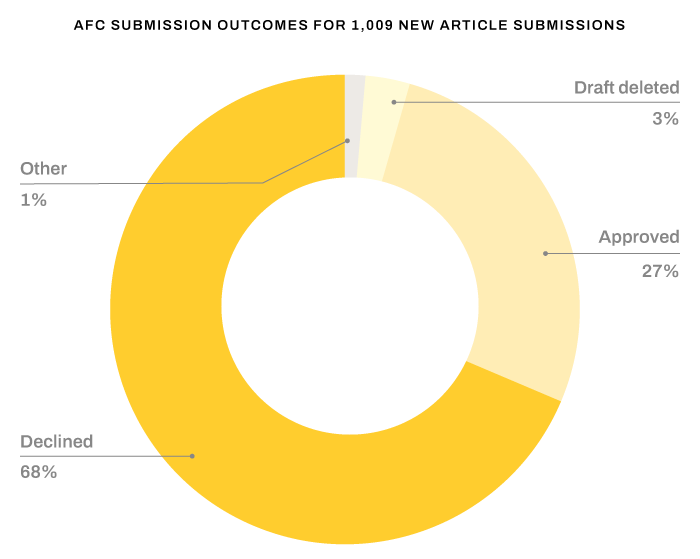
Lumino recently conducted an audit of over 1,000 Articles for creation (AfC) submissions on Wikipedia to better understand how often new articles are approved, what reasons editors give for declining submissions, and how approval rates vary by type of article. AfC is the main way new articles are published on Wikipedia—and the only compliant way to create a new article if you have a conflict of interest.
In our analysis, we found that editors approved only 27 percent of new article submissions. Meanwhile, they declined over two-thirds of AfC submissions: 68 percent. The top rejection reason was a "lack of notability" of the topic.