
How to engage on Wikipedia when you have a conflict of interest
On the main page of the English Wikipedia site, you'll see a banner that describes Wikipedia as "the free encyclopedia that anyone can edit." That sounds simple enough, right?

In reality, engaging on Wikipedia is quite a bit more complicated. While anyone can technically edit a Wikipedia article, the Wikipedia community has strict guidelines for editors when you have a conflict of interest (COI) with the topic of an article. Even what might seem like a simple update in an article can violate the site's policies, if you're not careful.
In this blog post, we'll explain how to know when you have a COI, what can go wrong if you fail to follow COI guidelines, and how to compliantly engage on Wikipedia when you have a COI.
How do I know if I have a COI?
If you work for or represent the company or person that's the focus of an article, are related to the person, or, really, are connected in any way to the subject of the article, Wikipedia considers you to have a conflict of interest. That doesn’t mean you’re banned from participating, but it does mean you have to take some additional steps—especially if you have a paid connection to the topic (for instance, if you're a consultant or employee of a company that is asking you to make edits). Here are the additional rules that apply when you have a paid COI with the topic of the article:
You cannot make direct edits to the article; instead, you can propose updates via the Talk Page
You must disclose your affiliation when you suggest changes
All proposed edits must be neutral in tone and backed by independent, high-quality sources (e.g., major news outlets—not press releases or blog posts)
This is because unlike other profiles of your company you may find on affiliates' websites or aggregator pages, a Wikipedia article is not "your" article. It's an overview of a topic that Wikipedia editors agree is important enough to warrant inclusion in an encyclopedia. When you're proposing changes as someone with a COI, the Wikipedia community will closely scrutinize your requests to ensure they comply with the guidelines of the site.
What can go wrong if you ignore COI guidelines
The potential consequences for breaking Wikipedia's conflict of interest guidelines, even if out of ignorance, range from bad to worse.
One common outcome is having a warning flag added to the header of the article. Readers will see this warning (or multiple warnings) that cast doubt on the content's credibility at the top of the Wikipedia article.
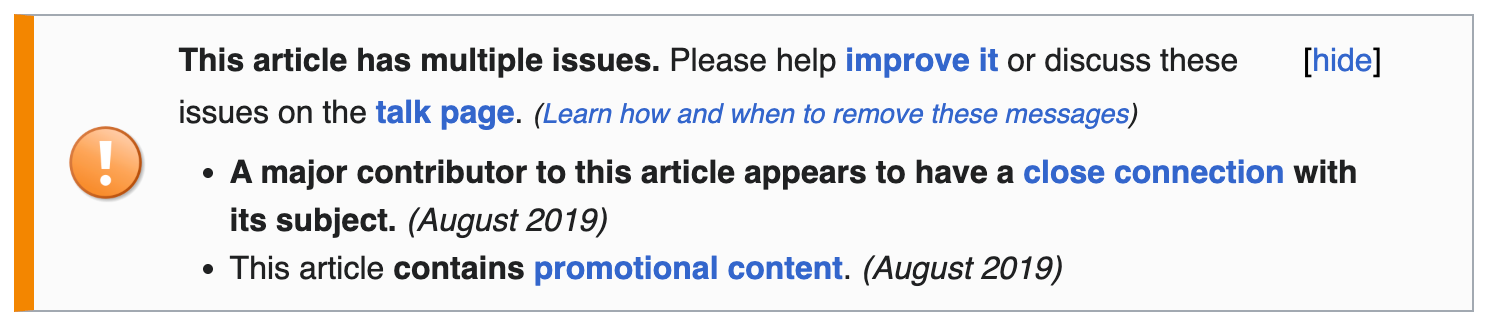
A Wikipedia "flag" warning readers of COI editing and promotional language.
Another common outcome is having editors delete content or revert changes they believe to be promotional, poorly-sourced, or added by a contributor with an undisclosed conflict of interest.

Article edit history log showing reversion of an edit deemed to be promotional
The Wikipedia community can and does take more permanent actions if editors break COI guidelines. To start, they may block your Wikipedia account.

Example of a user account blocked for "using Wikipedia for promotion or advertising."
If editors deem that one person is engaged in "sockpuppetry"—using multiple accounts to make edits, often to conceal a conflict of interest—the person, their accounts, and even their IP address may be banned from making edits on Wikipedia.
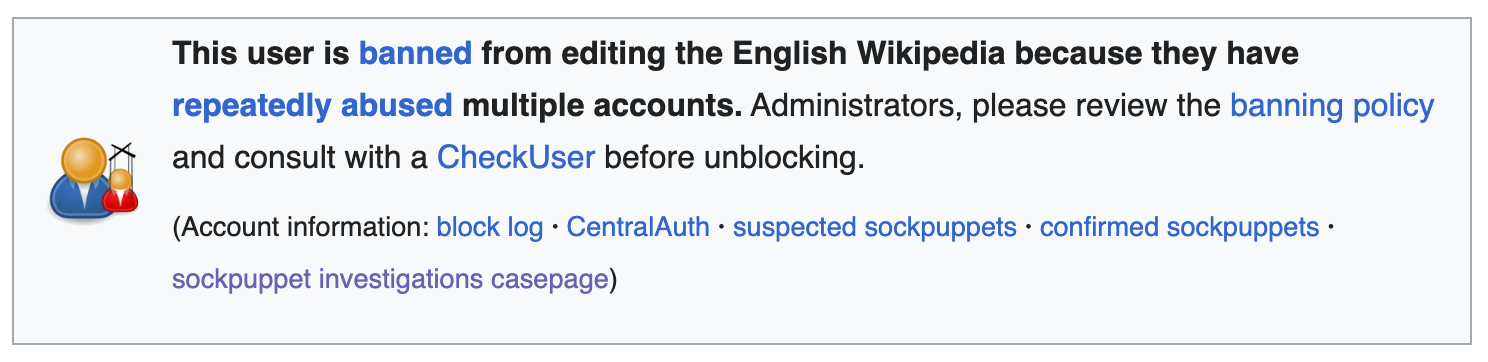
Content that appears on the user pages of accounts banned for sockpuppetry.
Beyond the actions editors may take against your user account (or accounts), engaging in undisclosed conflict of editing on Wikipedia can result in deletion of a Wikipedia article entirely. If editors find that an article lacks reliable sourcing, is written in a promotional tone, or that the topic of the article (like your company or an executive at your company) lacks notability, the article can be nominated for deletion. If editors do not find adequate sourcing to support the inclusion of the article on the site, it will be deleted.
For editors with a conflict of interest, this often happens when employees or contractors of a company or individual face pressure to create a new article without first ensuring that the topic meets Wikipedia's guidelines for creating a new article.
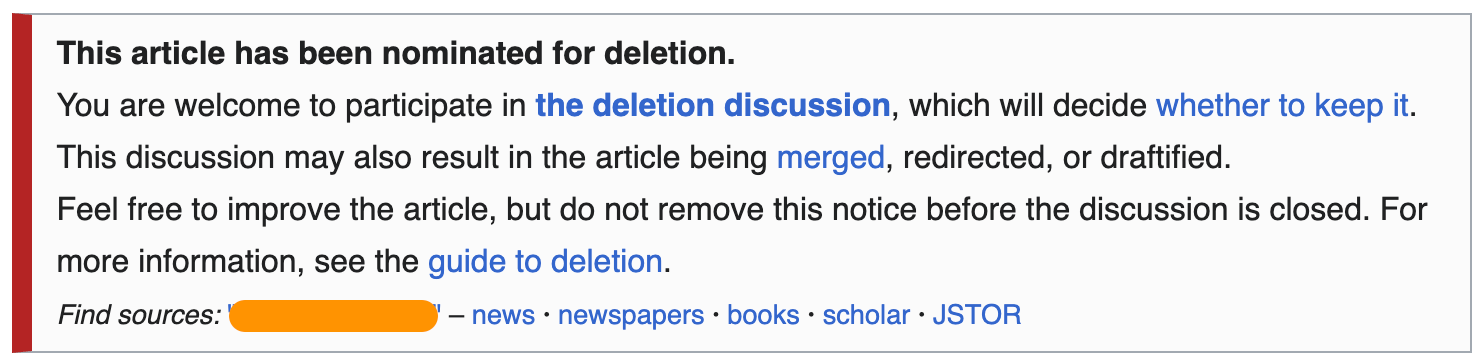
Example of a flag added to an article that has been nominated for deletion.
These risks are not hypothetical. The negative outcomes described above happen on Wikipedia every day, often leaving editors with a conflict of interest—and the articles they contributed to—in a worse position than before they started.
The good news is that editors can largely avoid these outcomes by following Wikipedia's guidelines for editors with a disclosed conflict of interest. Below, we take you through how to do so, step by step.
How to engage on Wikipedia while following COI guidelines
Step 1: Set up a user account on Wikipedia. Only one person should use your account: you. Choose a name that communicates this to Wikipedia editors, like "Devon from Z Corporation."
Step 2: Add a paid editor disclosure to your user page. This lets Wikipedia editors know who you are and who is paying you. We recommend using Wikipedia's {{Paid}} template.
Step 3: Add a disclosure on the Talk pages of any and all articles you'll propose changes to. We recommend the {{Connected contributor (paid)}} template for this. Adding this disclosure provides further transparency for editors engaged on the Talk page.
Step 4: Propose changes on the Talk page. It's best to make this easy for editors to implement by asking for specific, reliably sourced changes. For example, "I'd like to replace this sentence with this new sentence," or, "Could you help me add this new sentence to the History section?"
Step 5: Answer editors' questions and respond respectfully to their feedback. Arguing with Wikipedia editors, ignoring their critiques, or pushing editors to respond quickly will likely do more harm than good. Remember that editors are unpaid volunteers, not staff beholden to answering your requests.
Conclusion
Engaging on Wikipedia can be a daunting task, especially if you and your team have limited experience with the site and its complex set of guidelines. Lumino's team of Wikipedia experts is here to help you engage on Wikipedia ethically and effectively following the site's rules and best practices. Want to learn more about what we do? Reach out to us at shout@luminodigital.com.