
How hard is it for a CEO to get a Wikipedia article?

When you think of Microsoft, what comes to mind? It may be the Microsoft Office suite or the company's well-known logo; it's probably, also, Microsoft founder Bill Gates. The same goes for Amazon: Jeff Bezos. Apple: Steve Jobs, Steve Wozniak, and Tim Cook.
High-profile executives are a core piece of a brand's identity and public perception—so it makes sense, then, that so many marketing and PR teams seek to elevate the profile of their CEOs and other executives to grow their brand's presence. Companies now treat Wikipedia as an important part of a corporate PR and communications strategy, and their ambitions often extend beyond company Wikipedia pages to creating standalone pages for their CEO.
Getting a standalone page for a CEO or another member of the executive team isn't as easy as just setting up a Wikipedia account and making one, though. This blog post explores why it's so challenging for an individual person to get a Wikipedia article and what it takes to get one.
Wikipedia 101: Publishing a new article
While Wikipedia dubs itself "the free encyclopedia that anyone can edit," not all users on Wikipedia have the same privileges. Wikipedia has strict guidelines about creating and editing articles when you have a conflict of interest—for instance, if you work for the company whose CEO you’re trying to make an article for, or if you try to make an article for yourself.
The Articles for creation (AfC) process exists for exactly this purpose: to allow individuals with a conflict of interest (COI) to propose new articles in a way that ensures content aligns with Wikipedia’s standards for neutrality, notability, and quality sourcing before being approved and published. AfC is also used by people without a COI, and in many cases is the default process through which editors review most proposed new Wikipedia articles.
Lumino recently conducted an audit of over 1,000 AfC submissions on Wikipedia to better understand how often new articles are approved, what reasons editors give for declining submissions, and how approval rates vary by type of article.
We found that editors approved only 27 percent of new article submissions. Meanwhile, they declined over two-thirds of AfC submissions: 68 percent.
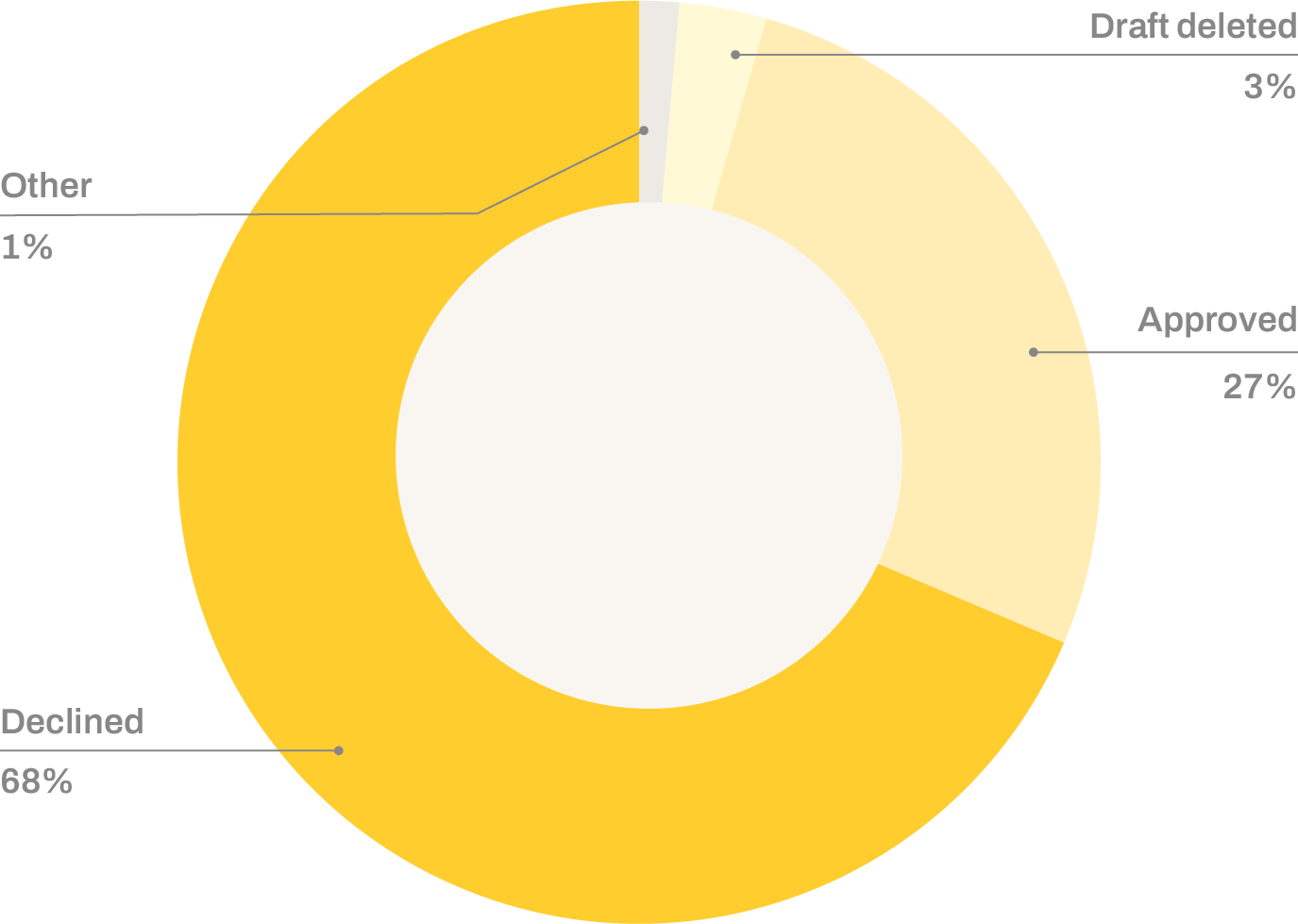
AfC submission outcomes for 1,009 new article submissions
Nearly half of the Articles for creation submissions in Lumino's sample—488 of 1,009 submissions—were proposed articles about an individual person. The Person category on Wikipedia refers to articles about individual people, living or dead, and is subject to specific rules around determining notability, citing sources, and protecting individuals' privacy.
The approval rate for Person submissions in our sample was 23 percent, slightly below the overall approval rate of 27 percent. But what about CEOs and business execs specifically? To answer this, we dug deeper into approval rates for subcategories within the Person category: Academia, Activist, Arts & Culture, Business, Government, Law, Media, Military, Other, Real estate, and Sports. Of these 11 subcategories, submissions for individuals associated with businesses—the category that accounts for most CEOs and other executives—turned out to have the lowest approval rate: 12 percent.
Put into real numbers from our sample: Only 9 of 76 AfC submissions for a Person (Business) were approved to become new Wikipedia articles.
Let's get into why this number is so low.
Why most new articles are declined: Lack of notability
Notability is Wikipedia’s primary criterion to determine whether a topic merits a standalone Wikipedia article. Notability is usually determined by media coverage. Specifically, Wikipedia editors look for “significant coverage in reliable sources that are independent of the subject” to determine whether a topic—like a company or an individual person—is eligible.
The top reason editors declined a submission for a Person was "lacks notability."
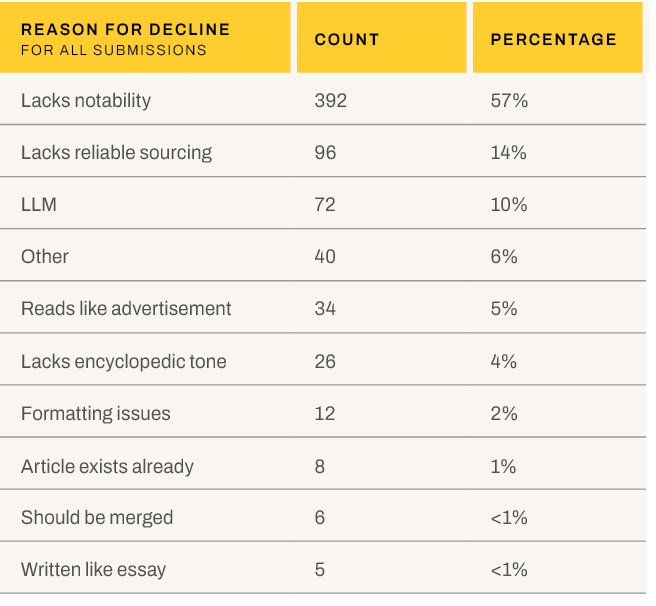
Demonstrating notability for a CEO or other business leader is particularly challenging. Why? By Wikipedia editors' standards, serving in a prominent role for a major company is not itself evidence of notability. Establishing notability for a person is difficult when media coverage focuses primarily on topics related to the company they work for, rather than the person's overall career or other accomplishments.
That means that standard coverage of a company may not help establish the notability of its CEO or another executive, even if the business leader is quoted extensively as a representative of the company.
What it takes for a CEO to get a Wikipedia page
The first and most important test a proposed article about a business executive must pass to qualify for a standalone Wikipedia article is notability.
To demonstrate notability for a person, Wikipedia's editors want to see multiple, in-depth journalistic articles in well-known national publications that focus on the individual, as well as a "hook" as to why the leader stands out in their field as a way that makes them worthy of inclusion in an encyclopedia.
Additionally, the draft must cite reliable sources to support all facts it includes, be written from a neutral point of view, and be sensitive to considerations around the individual's privacy—a standard specific to biographies of living persons on Wikipedia.
The best way to get a Wikipedia page for a business leader is to ensure they meet editors' standards for notability and reliable sourcing—and if they do not yet, to focus on gaining that media coverage before trying to get a Wikipedia page. Securing this kind of media coverage isn't easy, and it doesn't happen overnight.
Keep in mind, too, that Wikipedia articles do not "belong" to the individual about whom they're written, and CEOs and other business executives have limited control over what editors add to the article. In the Wikipedia essay, "An article about yourself isn't necessarily a good thing," the authors remind individuals seeking an article about the site's commitment to neutrality:
"An article about yourself is nothing to be proud of. The neutral point of view (NPOV) policy will ensure that both the good and the bad about you will be told, that whitewashing is not allowed, and that the conflict of interest (COI) guideline limits your ability to edit out any negative material from an article about yourself."
As your company's marketing and PR teams weigh the benefits of pursuing a Wikipedia article for their CEO or another executive, they should also consider the risks that come with biographies on Wikipedia.
Want to try to get an article?
Anyone who is looking to create a new Wikipedia article for an executive at your company (or for yourself) will come across many "black hat" vendors who promise to get a new page up for you in less than a day, "guarantee" your page will be approved, or make other false claims. They may get you a page at first, but don't be surprised if editors quickly delete the page, blacklist your IP address, and heavily scrutinize future attempts to bring back the page.
Here at Lumino, we begin the Wikipedia page creation process with an in-depth evaluation of an individual's media coverage and other mentions in reliable sourcing. We analyze the current media coverage and presence in the public domain to determine if we believe the person qualifies under the criteria of notability. If we believe the individual has enough coverage to meet editors' high bar, we guide your team through the Articles for Creation (AfC) process following Wikipedia's guidelines for editors with a conflict of interest. If the individual does not yet meet the standards for notability, Lumino will offer concrete guidance on what type of coverage you’re missing.
Curious if Lumino is the right fit to help you through the process of getting a Wikipedia article for a CEO or business executive? Let's talk. Shoot us an email at shout@luminodigital.com