
Key Wikipedia terms and acronyms for beginners
Online communities often develop distinct terminology and acronyms that mystify newcomers: Think "OP" (original poster) on Reddit or "AFK" (away from keyboard) on AOL Instant Messenger. Wikipedia and the Wikipedia editor community are no exception. While a casual reader of Wikipedia articles may rarely encounter Wiki-specific terms, once you engage on the site as a contributor, you may quickly become overwhelmed by the breadth of acronyms, jargon, and references used among experienced editors.
The official Wikipedia Glossary lists hundreds of terms and abbreviations—some of which new editors may encounter often, and others which are rarely used. Drawing on our 10+ years of experience on Wikipedia, the Lumino team has assembled a list of commonly used vocabulary and initialisms that new editors (especially those with a "conflict of interest") will encounter on the site. This list comes from our ebook Wikipedia and Crisis Communications, which details how PR and communications professionals should approach Wikipedia, especially when dealing with rebrandings, social media-driven firestorms, and other comms challenges.
Here are the terms you should know to get started.
Articles for Creation (AfC): A process designed to assist new editors in creating articles for the encyclopedia. Submissions are structured as drafts which can be reviewed by editors and improved by the submitting contributor after rounds of feedback. The AfC process is an appropriate way for an editor with a conflict of interest to create an article.
Articles for Deletion (AfD): The counterpoint to AfC, Articles for Deletion is a process for editors to nominate and vote on whether an existing article should be removed from the encyclopedia.
Admins: Like Agent Smith in The Matrix, admins are Wikipedia editors who have been granted special administrative abilities on the site. These actions include the ability to block (and unblock) user accounts, protect pages from editing, delete and undelete pages, rename pages without restriction, and use other tools for administrative purposes.
Banner: Broadly speaking, a banner (also known as a "flag") is simply a type of template used by editors to share information about a particular article. But the banners users often see on top of articles are often negative, having been placed there to provide a warning about content. A banner is generated when a Wikipedia editor places a tag on a Wikipedia article to indicate that the article's content is lacking in some crucial respect (usually sourcing, notability, conflict of interest editing, and/or tone) and may be in violation of Wikipedia editorial guidelines.
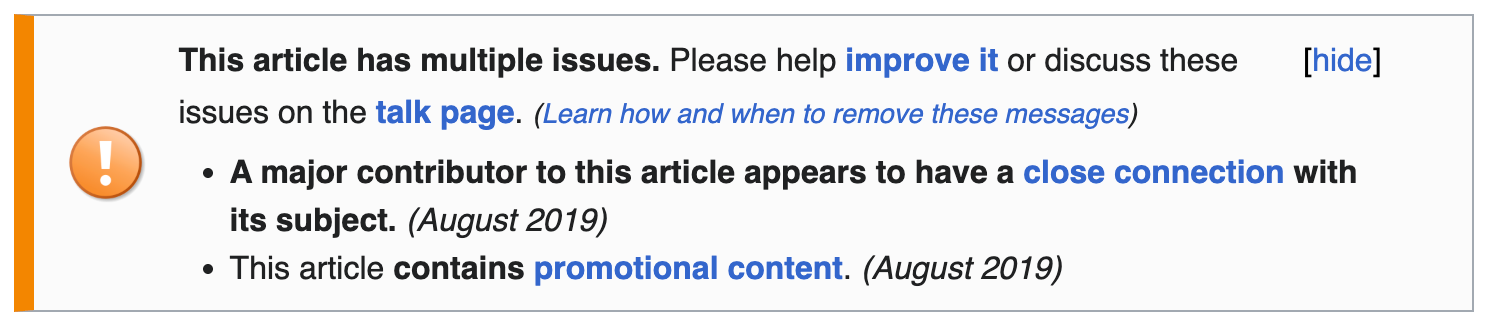
A Wikipedia banner warning readers of COI editing and promotional language
Canvassing: The recruitment of like-minded editors in order to influence the outcome of a discussion. Canvassing is considered inappropriate because it compromises the normal consensus decision-making process, and is generally considered disruptive behavior on the platform.
Conflict of Interest (COI): Wikipedia guidelines state that editors have a COI regarding any topic in which they have a financial or other vested interest. Wikipedia strongly discourages editors from making direct edits to articles in which they have such a conflict.
Diff Pages: Displays the difference between one version of a Wikipedia page and another. You can reach these pages by clicking on the “prev” button at the beginning of each entry in the revision history (see below).
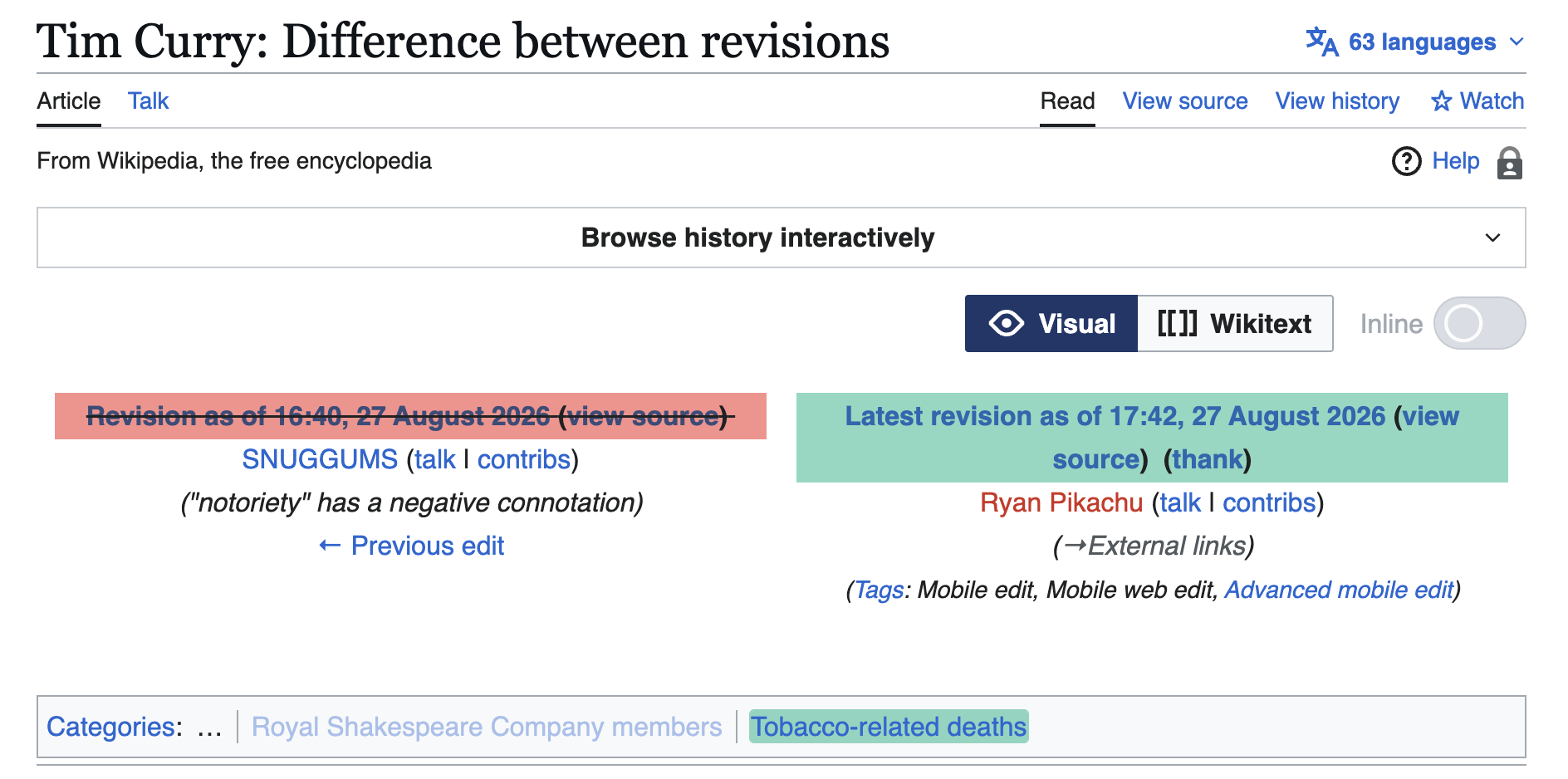
A diff view of a recent revision to the Wikipedia article on the late actor, Tim Curry
Edit War: This conflict occurs when editors who disagree about the content of a page repeatedly override each other’s contributions. Editors engaged in a dispute should reach a consensus or pursue dispute resolution rather than engage in an edit war, but don’t always come to a resolution.
Manual of Style (MoS): The style manual for all English Wikipedia articles that describes best practices and editor expectations for tone, capitalization, abbreviations, citations, use of images, and more.
Noticeboards: Administration pages where editors can ask questions and request assistance from people who are familiar with the policies and guidelines covered by each individual board. These pages are to be used for specific problems that editors encounter in writing and maintaining Wikipedia articles.
Neutral Point of View (NPOV): On Wikipedia, this means fairly and proportionately representing all the significant views that have been published by reliable sources on a topic, without editorial bias.
Original Research: A phrase used on Wikipedia to refer to material—such as facts, allegations, and ideas—for which no reliable, published sources exist. This includes any analysis or synthesis of published material that serves to reach or imply a conclusion not stated by the sources.
Peacocking: Also referred to as "puffery," "peacock terms" on Wikipedia are usually adjectives that make overly positive, subjective claims about a topic or person—such as "renowned musician" or "award-winning author."
Reliable Sources: Wikipedia guidelines state that articles should be based on reliable, published sources, and editors are supposed to ensure that all majority and significant minority views that have appeared in those sources are covered. If no reliable sources can be found on a topic, Wikipedia will not have an article about it.
Revert: Reversing a prior edit or undoing the effects of one or more edits, which typically results in the article being restored to a version that existed sometime previously. A partial reversion involves reversing only part of a prior edit while retaining other key parts of it.
Revision History: Every change to an article on Wikipedia can be viewed in the “View History” tab at the top right of the page. Wikipedia keeps a record of who made the changes, and precisely what the alterations were.
Sockpuppet: The use of multiple Wikipedia accounts by one editor (or a small group of editors) in a deceptive fashion in order to outnumber other voices, distort consensus, avoid sanctions, evade blocks, or other rule violations. If you have a personal Wikipedia account, it’s fine to create a separate account specifically for posting COI edit requests. But you should be transparent about this and note the existence of both accounts on the respective user pages.
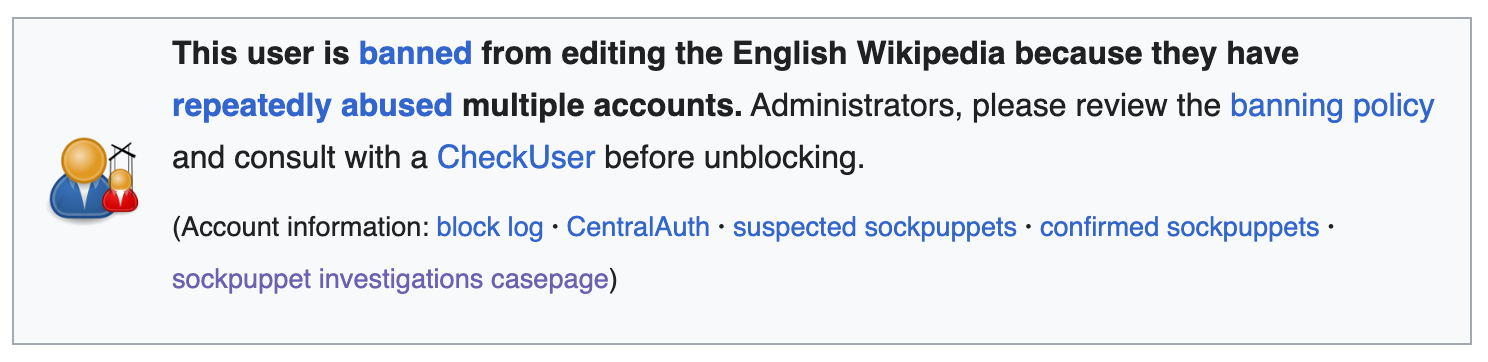
Content that appears on the user pages of accounts banned for sockpuppetry
Talk Page: Administration pages where editors can discuss improvements to articles or other Wikipedia pages. The talk page associated with an article is named “Talk:Example”, where “Example” is the name of the article.
Watchlist: A way to monitor what’s happening to any Wikipedia pages that you are interested in. When you choose to watch a page, your user watchlist will automatically populate with the most recent edits that have been made to that article (and Talk page).
Weasel Words: Words and phrases aimed at creating an impression that something specific and meaningful has been said, when in fact only a vague or ambiguous claim has been communicated. A common form of weasel wording is through vague attribution, where a statement is dressed with authority, yet has no substantial basis.
Wikilawyering: The process of debating and arguing directly from Wikipedia’s policies about the kind of content that should or should not be on a page. Wikilawyering comes with its own risks, especially if you aren’t fully versed in Wikipedia’s rules.
WikiProjects: A group of contributors who want to work together as a team to improve Wikipedia. These groups often focus on a specific topic area, a specific part of the encyclopedia, or a specific kind of task.
Want help with improving a Wikipedia article while following the site's "COI" rules? Our team brings over a decade of experience helping clients navigate the complexities of Wikipedia in compliance with the site's guidelines.
Reach out to Lumino at shout@luminodigital.com to learn more about our services.