
What is the Wikipedia Talk page?
Consider the iceberg.
In Wikipedia & Crisis Communications, a comprehensive guide to PR hygiene on Wikipedia by Lumino founder Rhiannon Ruff, we’re introduced to the metaphor of a big frozen chunk in the ocean.
This is where we learn that what more casual users might consider all of Wikipedia is really just the tip of the site, poking out from the surface. Beneath is a whole tranche of pages: the inner workings of a bigger system.
While there are several million Wikipedia articles, there are dozens of millions of Wikipedia pages.
Shifting metaphors
Think of Wikipedia articles as the site’s product, and the pages as the larger factory that produces them. If Wikipedia's volunteer editors are the factory workers in this metaphor, they can’t effectively do their job to grow the encyclopedia without tons of administrative, navigational, and coding resources. Their sausage factory has to be a lot bigger than the sausages it churns out.
The encyclopedia articles that users read and learn from—and that LLMs and Google knowledge panels pull from—sprout from this underlying collection of pages containing code, discussion, revision history, and shared Wikipedian resources.
Today, we’ll focus on just one of the important page categories of the site.
The Talk Page
The Talk page is where editors can discuss what’s in a given Wikipedia article—or what could be in the article, depending on the outcome of discussions and requests.
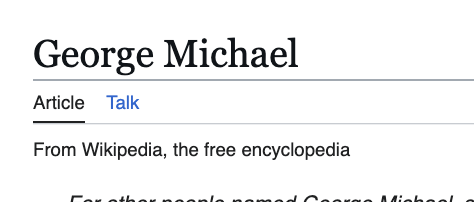
Every Wikipedia article has a Talk page, and anyone, whether you have an account or not, can look at it. While only a small percentage of Wikipedia visitors look at its Talk pages, they’re not exactly hidden. Right beneath the title of an article, you’ll see the option to toggle from “Article” to “Talk”:
The first thing you’ll often see, on the Talk page, is a yellow box that looks something like this:
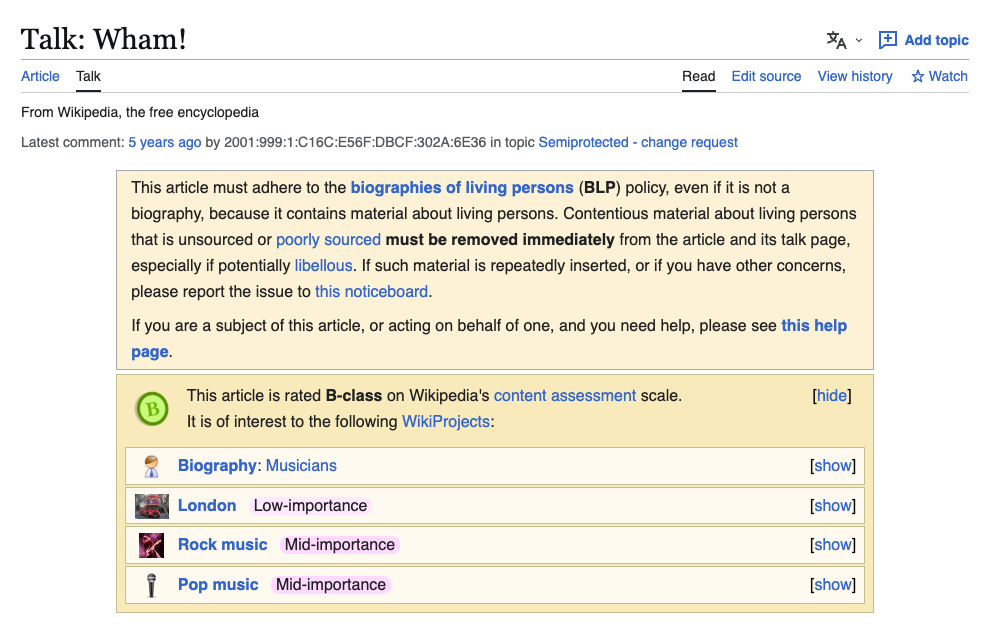
This box, otherwise known as a Talk header, provides a rundown on important status and issue questions regarding the article, as well as organizing it under the WikiProjects that are most relevant to the subject, and the size of the header can vary.
The box at the top of George Michael’s Talk page is, for example, much larger than the one pictured above that appears atop the page for Wham!, the dance pop duo he was part of before going solo.
What the size of the Talk page header means
A bigger header can mean a few things. Sometimes, there are simply a lot of different ways to file, classify, or categorize an article subject.
In the case of the article for George Michael, it’s been associated with several WikiProjects—these are subject-specific teams doing long-term quality control, essentially—which include: Biography, LGBTQ+ Studies, Western Asia (an apparently defunct WikiProject), London, Pop Music, and R&B Soul Music. The man has crossover impact.
In the short term, a bigger Talk page header box can also signify that there are specific editing rules and/or editor community issues related to the article topic (or the broader topic that it falls within)
The header for a Talk page behind an article about a recent contentious political story, for instance, can become quite long, due to the numerous editorial challenges involved in maintaining the article. For example, there may be warnings about sanctions for edit warring, intended to stop editors from battling it out in the article's edit history and instead to bring their arguments to the Talk page to resolve. Or you may see a notification relating to sourcing requirements for contentious topics.
The next time you see a celebrity in the news for the wrong reasons? Check their Talk page over the following week or so, and watch that yellow box grow. If things get really heated, you might even see some red in that yellow, meaning that editors have imposed pauses or restrictions on article activity. Over time, as attention shifts and users move on, these hot-story headers normally revert to normal size.
Right under the header, though, is where the Talk page earns its name.
What we talk about on the Talk page
Much of what editors discuss here is more mundane and organizational, like whether or not to re-divide the article’s structure, giving it more sections with more sub-headers; or conversely, whether to collapse and simplify the article.
But discussions will also include more ethical concerns, like the quality or objectivity of sources cited in the article.
This is where business reputations come in. The Talk page is the perfect place for professionals to note their conflict of interest (COI), introducing themselves to Wikipedians and laying out their intentions with the company page. Any edit request made on behalf of your company, no matter how simple, is considered a COI edit request.
Even in the case of simple data adjustments, the Talk page is where you should come first to make your disclosure and request the change. There is no way around Wikipedia’s editors, and their goal of maintaining the neutral point of view (NPOV) of Wikipedia.
After establishing a COI, companies can propose edits for seasoned users to review and, ideally, approve.
Hard and easy Talk page discussions
Requests for objective, verifiable information revisions, like the size of the company, a rebrand, or new leadership names, are simply easier for editors to review and complete, without much back-and-forth needed.
More complicated COI edit requests are more likely to get the Talk page talking. If you're looking to add detailed subject histories or statements about broader industrial or cultural impact, make suggestions for alternate sourcing, debate appropriate phrasing, or present ideas about adding or restructuring article sections, be prepared to discuss with editors and provide well-reasoned, well-supported explanations.
More ambitious edit requests like these are great to make, for the long-term reputation of your company. But there is a waiting game for review and, often, a need for back-and-forth with active editors to make them stick.
Why companies need the Talk page
Direct, self-interested editing, with undisclosed intentions, is never a path to lasting change on a Wikipedia article. Technically speaking, you can skip the Talk page, but it’s not a good idea.
While it may take a while for anyone to notice them, edits made without going through the Talk page first will always be ripe for deletion.
This is always a shortcut to getting on the bad side of Wikipedia's volunteer editors, who tend to have elephant memories.
The best way to improve your company’s page in a strong and enduring way is to understand Wikipedia editors, and work with them. The Talk page is where those connections happen.
The mission of the Wikipedia community, however imperfectly it’s pursued, is to maintain the world’s largest free, open, and accurate digital encyclopedia.
So long as you seek to update your company’s page in this spirit, you can find common ground with them—at the end of the day, both your company and Wikipedia’s editors want a correct, up-to-date, informative article.
Want to know more? Schedule a free consultation with our team, right here!