
Difference Between Traditional SEO and AI Search Optimization
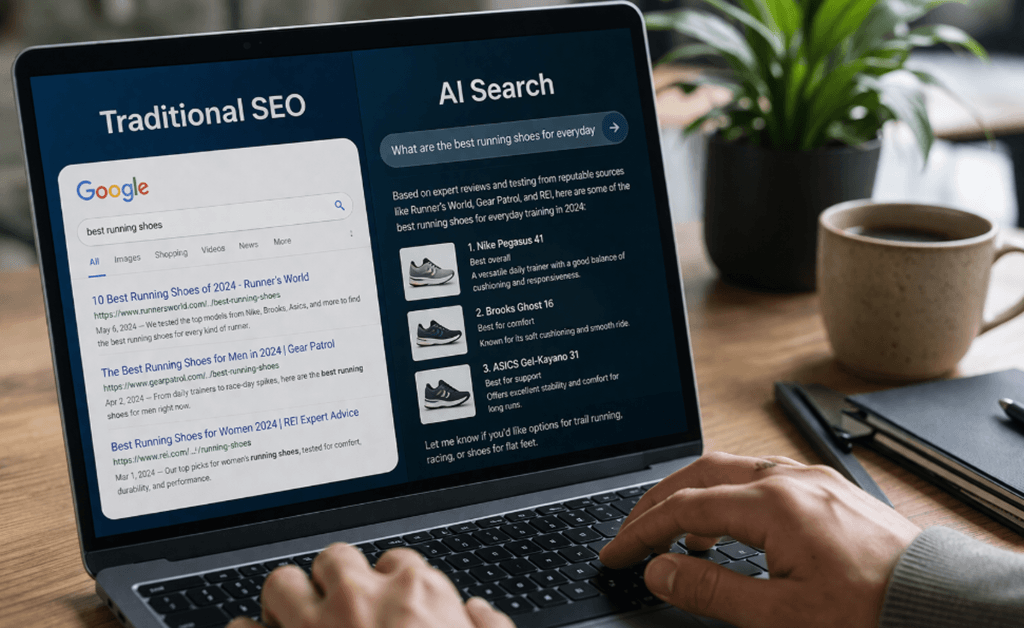
The way people search for information online is witnessing a paradigm shift. For so long, we have optimized our online content through search engine optimization techniques following a particular set of guidelines to rank websites. But with the emergence of artificial intelligence and generative answer engine technology, the rules keep changing.
Companies are continually trying to learn to distinguish themselves between what has traditionally become known as conventional search engine optimization and what has become the need for search engine optimization through artificial intelligence.
In this guide, we establish the key difference between these two fields. Conventional search engines focus on answering with a list of relevant resources, while AI-based search engines focus on answering with a synthesized response. This is what shapes the way we should address our digital strategy.
Understanding Traditional SEO Mechanics
“Traditional” SEO builds a map for the search engines. In terms of what we do from a traditional SEO standpoint, we are talking about the building of the map for the crawlers. It is all about proving to an algorithm that the page in question is the most relevant page for the user for a specific question. In doing so with a traditional SEO campaign, we target specific words - traditional SEO vs AI-driven SEO differences are thus crucial to grasp for a modern marketer.
In this domain, the achievement comes from measurements such as domain authority and click-through rates. Click-through rates are weighted heavily. The way the search engine operates involves it acting like a librarian, and it’s our task to make sure the book we “wrote” has the right title and goes on the right bookshelf so it gets suggested by said librarian. Site speed and mobile optimization are emphasized because if the browser can’t crawl it easily, it won’t recommend it to users.
The Emergence of AI Search Optimization
The optimization of AI search demands a different mentality since the way the technology handles the information is different. The Large Language Models (LLMs) and the generative search engines not only index the information but read and synthesize it. When optimizing on AI, we optimize the response, not the link. This is usually called Generative Engine Optimization (GEO).
This is an environment where keywords are considered less important than semantic meaning. The algorithms search for patterns and hierarchy. We notice that in this case, semantic language fares better, as it resembles how the average user phrases their queries to chatbots and virtual assistants.
The algorithms aim to provide a comprehensive answer. This means that we are no longer trying to persuade a spider to rank our page higher. Rather, we are persuading an AI tool to cite us in its response. This process can sometimes involve a Wikipedia AI search performance audit to benchmark content authority and accuracy in AI-generated answers.
Establishing a Hybrid Approach
In our opinion, the only way to move forward is to stop relying solely on SEO and instead merge it with the principles of AI-optimized search. The technical aspect of SEO remains relevant because AI algorithms still need to crawl your site to access the information. If your site doesn’t have a working technical aspect, Google or the LLM won’t be able to crawl the site.
However, we have to add a new layer of strategies aimed specifically at AI. This allows us to do more than just keyword stuffing, and instead focus on answering tough questions in-depth. We make our content amenable to comprehension by machines by using actionable headlines to directly respond to a user query.
Experience/expertise, authority, trustworthiness (E-A-T) are more important than ever because AI is programmed to rely on trustworthy sources to lower “hallucinations”. This blend of methods highlights the ongoing evolution of AI-assisted SEO vs traditional SEO optimization as we balance human intent with machine understanding.
Embracing the Evolution of Search
This shift from traditional search engine optimization to search optimization through AI is a step forward and not a replacement. It is important that we improve technical optimization while at the same time enhancing the quality and sophistication of content needed for algorithms. We learn from understanding that link information is organized through one technology and answered through another.
Businesses that will succeed and thrive through this period will be those businesses with the most accurate answers to any questions asked. To move forward with your AI strategy, contact Lumino Digital today!
