
Can a tech startup get a Wikipedia page?

Just about every company wants its own Wikipedia page these days, and it’s no surprise why: Wikipedia is one of the top sources cited in searches within AI large language models (LLMs), so it has a huge impact on how audiences learn about your brand.
If you do marketing or PR for a tech startup, or you're a startup founder, you may understandably want to get a Wikipedia article for your company up as soon as possible. And besides, you've got media coverage to back it up: a Crunchbase profile, your latest Series B covered in Bloomberg, a monthly column for Forbes Technology Council, and maybe even a partnership announcement in TechCrunch.
You're ready for a Wikipedia page then, right?
Unfortunately, even with all this coverage, the answer is likely "no."
To explain why, let's take a step back: to Wikipedia's Articles for creation (AfC) process. We'll explain what this is, how it works, and what it takes for companies to get a new article approved through this process.
Creating a company Wikipedia page
To start, getting a Wikipedia article isn’t as easy as just making one. That’s because Wikipedia has strict guidelines about creating and editing articles when you have a conflict of interest—like if you work for the company you’re trying to make an article for, or if you try to make an article for yourself.
The Articles for creation (AfC) process exists for exactly this purpose: to allow individuals with a conflict of interest (COI) to propose new articles in a way that ensures content aligns with Wikipedia’s standards for neutrality, notability, and quality sourcing before being approved and published. AfC is also used by people without a COI, and in many cases is the default process through which editors review most proposed new Wikipedia articles.
Lumino recently conducted an audit of over 1,000 AfC submissions on Wikipedia to better understand how often new articles are approved, what reasons editors give for declining submissions, and how approval rates vary by type of article.
We found that editors approved only 27 percent of new article submissions. Meanwhile, they declined over two-thirds of AfC submissions: 68 percent. The top rejection reason was "lack of notability"—we'll get into this more later.
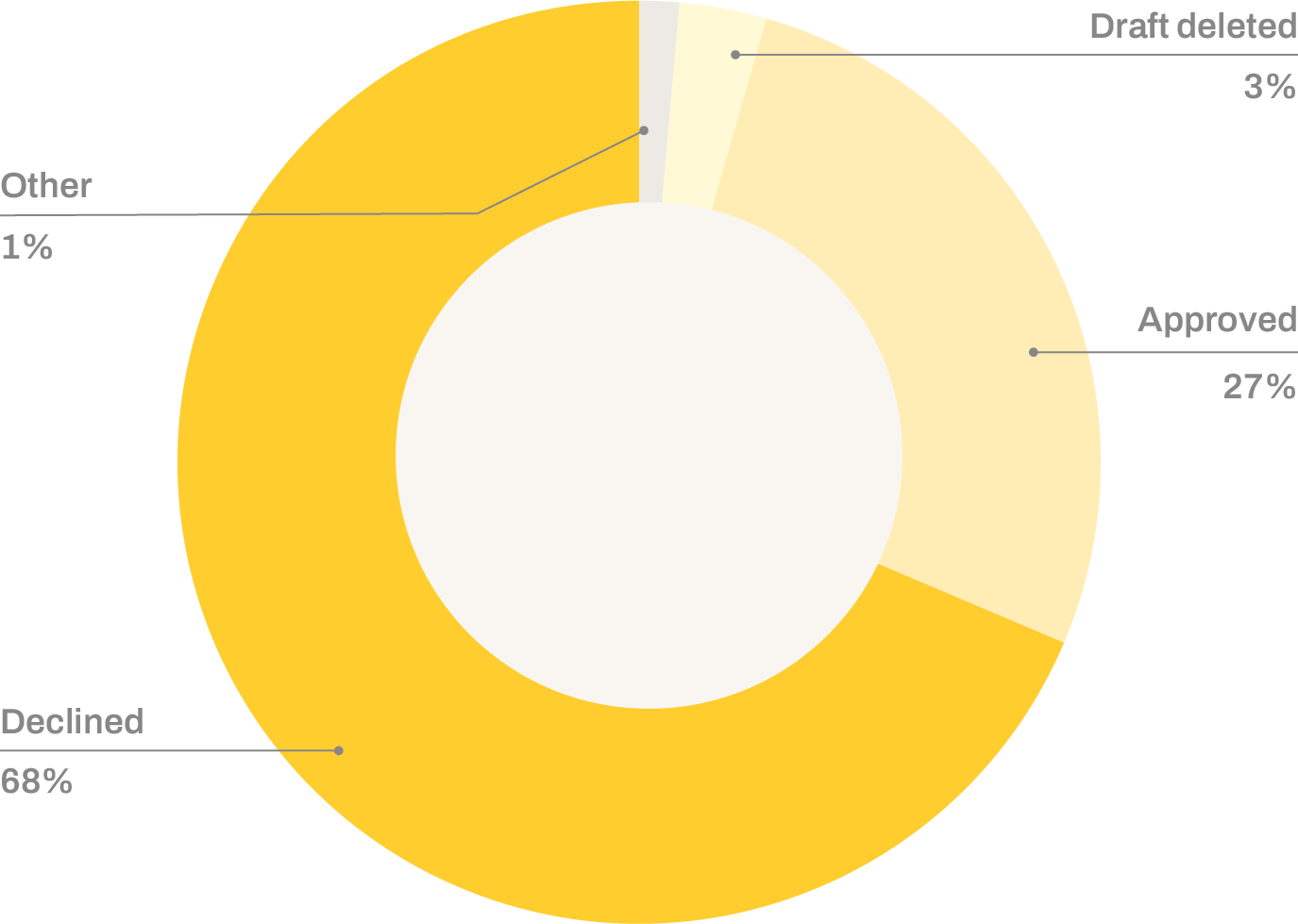
AfC submission outcomes for 1,009 new article submissions
What is "notability" on Wikipedia?
Notability is Wikipedia’s primary criterion to determine whether a topic merits a standalone Wikipedia article. Notability is usually determined by media coverage. Specifically, Wikipedia editors look for “significant coverage in reliable sources that are independent of the subject” to determine whether a topic is eligible.
Wikipedia even has specific criteria for notability for organizations and companies, as well as guidelines about what count as "reliable sources." Much of the media coverage your startup or tech company has earned may not meet Wikipedia editors' standards for notability.
For instance:
Crunchbase is a no-go. It is currently listed as a deprecated source—in the context of Wikipedia, this means that editors have come to the consensus that the source is "generally unreliable" and should not be used.
Funding announcements don't confirm notability. In the eyes of Wikipedia editors, this sort of announcement is so common in the startup world that it isn't "notable."
Forbes "contributors" are not journalists. And yes, Wikipedia editors will check if the Forbes article you cite is bylined by "Staff" (acceptable) or by a "Contributor" or "Senior Contributor" (not acceptable).
Press releases don't count. Wikipedia editors treat press releases the same way they do information published on your company website or blog, not as independent coverage.
Even TechCrunch is iffy. Current guidelines suggest making careful use of TechCrunch sources, as they may be unduly influenced by press releases and other non-neutral sources.
Given these strict requirements for independent, reliable sourcing to establish notability, it's no surprise that "lacks notability" and "lacks reliable sourcing" top the reasons that Wikipedia editors decline AfC submissions.
What does it take for a tech company to get a Wikipedia page?
From our audit of AfC submissions, we found that businesses had the lowest approval rate of any category of new article submission: just 15 percent.
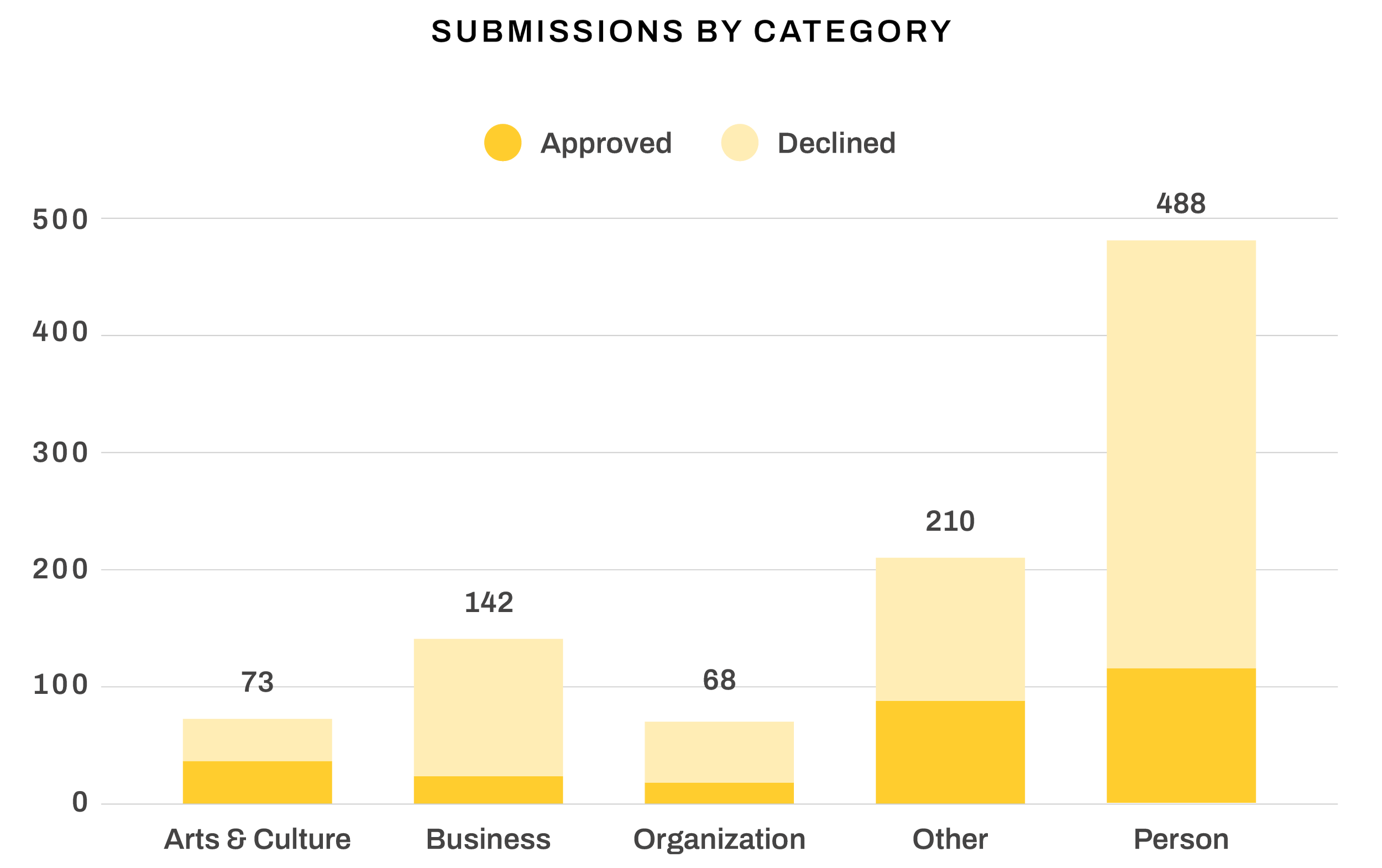
Count of AfC submission approvals and declines by category
Drilling down further into sub-categories, we found that technology-focused businesses fared especially poorly, with only a 6 percent approval rate.
Other business sub-categories in Lumino's sample fared considerably better: submissions for "hospitality" businesses had a 27 percent approval rate, for example.
We believe there are two key reasons why "technology" businesses are so unsuccessful with AfC submissions. First, because these businesses operate in the online space, they are well aware of the benefit of having a Wikipedia article for AI search and may push to get one quickly—before the company meets Wikipedia's standards for notability.
Second, technology businesses (including small startups) often do have an abundance of media coverage, and it may even be in major news sources like Bloomberg. Comms teams or startup founders with a cursory understanding of Wikipedia may see this coverage as sufficient for sourcing a new article for their company. However, media coverage of new tech companies is typically related to funding rounds or corporate partnerships—and unfortunately, in the eyes of Wikipedia editors, these are considered "trivial coverage" of a company.
To pass Wikipedia editors' high bar for notability, tech companies and startups should have at least 2-3 instances of "substantial coverage." Here's what this means, according to the site's guidelines on notability for companies and organizations:
Examples of substantial coverage that would generally be sufficient to meet the requirement:
A news article discussing a prolonged controversy regarding a corporate merger,
A scholarly article, a book passage, or ongoing media coverage focusing on a product or organization,
A documentary film exploring environmental impact of the corporation's facilities or products,
An encyclopedia entry giving an overview of the history of an organization,
A report by a consumer watchdog organization on the safety of a specific product,
An extensive how-to guide written by people wholly independent of the company or product (e.g. For Dummies).
From Wikipedia:Notability (organizations and companies)
Final thoughts
If you're looking to create a new Wikipedia article for your tech startup, you'll come across many "black hat" vendors who promise to get a new page up for you in less than a day, "guarantee" your page will be approved, or make other false claims. They may get you a page at first, but don't be surprised if editors quickly delete the page, blacklist your IP address, and heavily scrutinize future attempts to bring back the page.
The best way to get a Wikipedia page for your company is to ensure you meet editors' standards for notability and reliable sourcing—and if you do not yet, to focus on gaining that media coverage before trying to get a Wikipedia page.
Here at Lumino, we begin the Wikipedia page creation process with an in-depth evaluation of your company's media coverage and other mentions in reliable sourcing. We analyze the current media coverage and presence in the public domain to determine if we believe you qualify under the criteria of notability. If you are ready, we guide your team through the Articles for creation (AfC) process following Wikipedia's guidelines for editors with a conflict of interest. If your company does not yet meet the standards for notability, Lumino will offer concrete guidance on what type of coverage you’re missing.
Remember: Getting a Wikipedia page is a marathon, not a sprint. Curious if Lumino is the right fit to help you through this process? Let's talk. Shoot us an email at shout@luminodigital.com